“ Education is the passport for the
future, for tomorrow belongs to
those who prepare for it today. "

ARCH Philosophy

To customise need-based programs for schools that integrates in their existing system and adds long-term growth value to students and teachers.

The big idea is to collaborate with all key stake holders to ensure program success and sustainability with in designated time line.

Of all the socio-economic problems that we face, the lack of good education is one of the most alarming in India. More than 60 million children between 6-14 years of age have never been to school. Such illiteracy is rampant and the root cause for many other social evils that holds back economic and social development of the country.

ARCH focuses not only to address issues concerning access to education, but also to ensure that every child has access to meaningful education.

ARCH designs programs with strong result orientation that makes learning interesting and innovative for students. All programs are custom-made with a realistic view of the available resources and there is a 360 degree closure mechanism to ensure success. ARCH believes that education brings academic development as well as personality enhancement in children. Better learning will result in higher self-esteem, better co-operation and increased gender-equality resulting in high quality development of the nation.

Components of activities in Education as designed by ARCH

  • Need based learning programs

  • Curriculum Designing

  • Resource Allocation

  • Program execution, administration, training & evaluation

  • Scholarships

  • Infrastructure development

Inspirational story from ground

Deaf people can do anything, except hear.

This is our deep-rooted belief at ARCH.

We have full faith in the abilities of differently-abled people and focus in developing social and technical skills in them in order to empower them to lead a normal life.

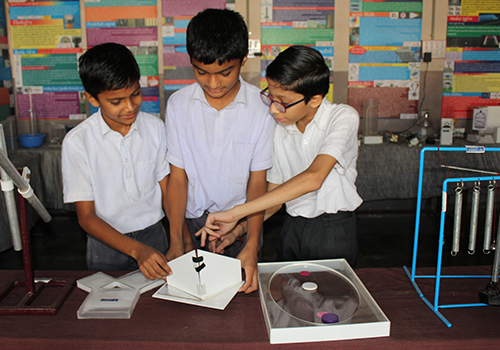
In 2016 we started work with the deaf and mute students of Smt. Kamlaben Badhir Vidyalya by installing the Mini Science Lab in their school consisting of 60 working models based on science and maths.

These students, suffering a mental block of limitations, had inadequate experience in the field of experimental science. So when we first approached them to participate in a Science Fair they were taken aback. The initial shock made way for strong resistance to participate.

After one month of persistence and encouragement from our side they finally gave us their nod. To our extreme delight and everyone’s amazement these differently-abled children did a splendid job at the Science Fair where more than 200 students from government aided and corporation run schools were participating.

In fact they won the trophy for the Best Model of physics based principle. Such an achievement was beyond their imagination as they always considered themselves a shade inferior to normal children.

This victory was not theirs alone, it was ours too! For once again we were able to prove that excellence is not dependent on physical capability but mental ability. We’re very happy and proud to share now there’s no looking back for these young and bright students of Smt. Kamlaben Badhir Vidyalya who have relentlessly participated in all science quizzes and other competitions since then.

projects / programs

Mini Science Lab – Project Eureka
+
-
target groups
Government aided and corporation run school children and teachers
Outreach
20,000 students and 500 teachers

Kids are natural scientists. It is this thought that gave birth to Project Mini Science Lab. While kids are born with an ability to explore and discover their surroundings, the burden of the formal and rigid education structure has started to kill the spirit of self – learning in them.

To address this issue and to keep the excitement and ignition of science burning ARCH has designed, developed and implemented Program Mini Science Lab. With more than 15000 students and 500 teachers benefitted to date, this is an on-going project in primary level government aided and corporation run schools. The program is holistically created with 4 strategic areas of outcome:

1. Improving quality of access to education & learning, especially for students from less privileged sections of society. This is achieved by setting up of Mini Science Labs in the school and ensuring that children and teachers routinely use it as a part of their formal curriculum. A log book is maintained on a daily basis to assess its proper usage.

2. Enhancing capacity and skills of teachers to teach science and mathematics in more effective and interesting ways at school. Routine workshops and module based trainings are held to educate the educators to hone teaching skills and exchange ideas to keep the class interactive, engaging and effective. Routine assessments keep a check on the effect of improved skills.

3. The students and teachers are given a platform to exhibit and execute learning through the customized programs. Periodic debates, science fairs and science quizzes are held to keep the learning interesting and eventful. Children get an opportunity to showcase their talent and knowledge acquired in a competitive space.

4. Create partnership and collaboration with various stakeholders for the sustainability of the project. A project management company is established with principals and administrators of different school to manage and review the program. There is a periodic advocacy meeting that works towards smooth planning and implementation of the Mini Science Lab.

Project Umang Activity & Resource Centre
+
-
target Schools
Government primary schools
Outreach
> 4000 students

Issues addressed – Irregular / low attendance of students/reducing drop-outs,/improving learning level of students/ building confidence and enhancing creativity, imagination and expressions

Big challenge facing Government schools is of low student attendance. In spite of no school fees students are irregular in attending school and the drop-out rate is alarming.

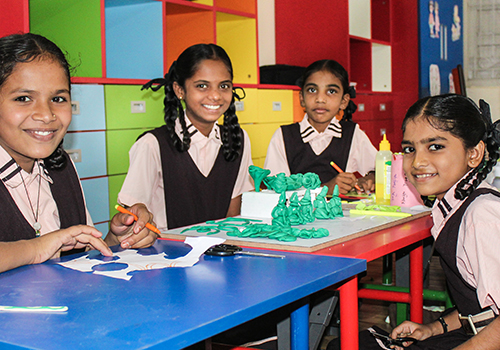
ARCH has developed a unique program called Umang to address this low attendance issue and develop a curriculum to enhance creativity and fun in everyday school. Project Umang has a two-way learning curve where creativity is promoted in the structure of education and vice-versa. The students are given a unique platform to explore the joy of learning. It is held everyday, as part of the formal curriculum of the school, where our educators spend time with children delivering the extensive project module.

With an outreach of over 4000 students belonging to primary schools run by government, Project Umang has been a runaway success. The children are exposed to art and craft where fun activities are integrated with the syllabus of Grade 1 to 8.

Further, they are exposed to performing arts in the form of music, dance and theatre where their self-confidence gets a mighty boost. The focus mainly lies on better presentation skills, expressions and voice modulation that help overcome their stage fear and prepare them for different walks of life.

Spoken English, an important aspect of learning in this program emphasizes on developing conversational skills in the English language.

Concepts of maths and science are promoted through a series of workshops with teachers and students using the methodology of demonstration, construction and presentation. This enhances curiosity and makes difficult concepts easy to understand and use in everyday life.

WOW from the Waste
+
-
target groups
Government primary & secondary schools
Outreach
> 800 students and > 200 teachers

The focus of this unique program is to introduce the students to waste management and the concept of making the best out of waste. They are oriented to recycle what would normally be tossed into dustbins each week and create awareness about looking at JUNK as a tool for science and innovation.

This new light on exploring waste encourages divergent thinking in children. It’s sheer joy to let them use plastic, buttons, metal objects, wooden pieces, screws etc. in innovative and out-of-the-box experiments and watch interesting outcomes.

This initiative further teaches schools and students to look at resource management while setting up science labs on a small budget. Indeed a fun way to learn!

Theatre for a cause
+
-
target groups
Government primary & secondary schools
Outreach
> 300 students

Students of government schools are generally exposed to rigid education curriculums that focus on subject, limiting knowledge to marks and grades. The opportunity to expose them to extra-curricular skills is often overlooked.

However, the theatre workshops held by ARCH aim to create a nurturing environment for kids from under-served communities who have a love for performing arts.

Our intensive training and coaching help perfect their voice modulation, dance skills and acting ability and pave way for developing self-sufficiency, confidence, and discipline – important life skills that determine the overall success of a child.

Such a workshop can be incorporated as an ongoing and long-term program or as a standalone program of the school. So far 300 students have benefitted from our theatre workshop.

ROBOTICS & ELECTRONICS WORKSHOP
+
-
target groups
Government primary & secondary schools
Outreach
> 250 students

Children are untapped creative powerhouses. The robotics and electronics workshop is designed to channelize their creativity with relevant knowledge enabling them to make DIY projects on different subjects of their interest.

The outcome of this workshop has been very encouraging to say the least as the participants create novel models that lift their own understanding of concepts in science, engineering and technology.

With digital technology paving way for the future such a workshop is an eye opener for students to think of the unthinkable and build on inventions. So far 250 students belonging to government run primary and secondary schools have benefitted from the robotics and electronics workshops.

Endorsements

My school is the beneficiary of Project Umang; planned and executed by ARCH Development Foundation. I appreciate the efforts that ARCH has put in to plan innovative activities on a daily basis and create a joyful learning environment for students and teachers. I have already noticed significant behavioral and motivational improvement in them. Congratulations ARCH for your noble efforts and hard work!

Vimal Acharya

Principal - Haripar Primary School, Rajkot

I have been taking part in various quiz competitions but Project Science Mini Lab was a unique experience for me. It was one full day of learning in an entertaining and interesting way. It was very well conducted and I would love to participate again.

Sankesh Patil 

Class 8th – Sadhu VaswaniVidhyaMandir
© ARCH Development Foundation. All Rights Reserved
An ACTONATE Development